ID1050-XDS vs ID1300-XDS: What Changes When You Size Up?
Consider the Injector Dynamics ID1300-XDS when the tuner needs more injector flow and differential fuel pressure is holding steady. If pressure falls under load, investigate the fuel supply first. A tuner who still has adequate duty-cycle margin with the ID1050-XDS may have little reason to size up.

Consider the Injector Dynamics ID1300-XDS when the tuner needs more injector flow and differential fuel pressure is holding steady. If pressure falls under load, investigate the fuel supply first. A tuner who still has adequate duty-cycle margin with the ID1050-XDS may have little reason to size up.
Read each manufacturer test condition
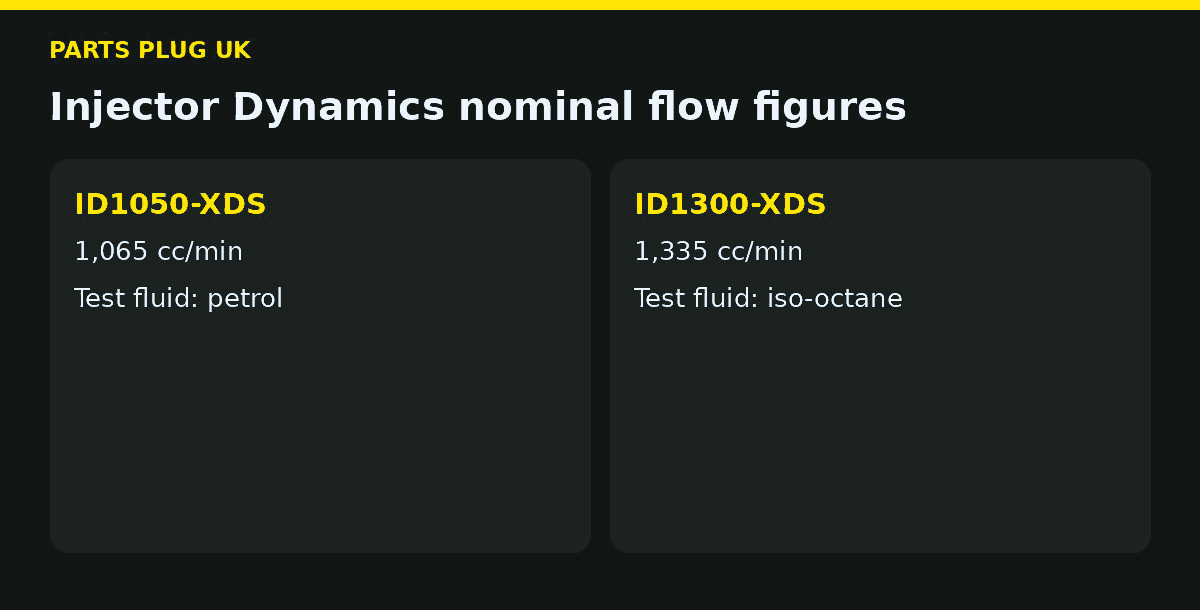
Injector Dynamics publishes nominal figures of 1,065 cc/min for the ID1050-XDS and 1,335 cc/min for the ID1300-XDS at 3.0 bar differential pressure and 52 °C. The ID1050-XDS was measured using petrol and the ID1300-XDS using iso-octane, so the figures are published reference points measured with different test fluids. Differential pressure is the difference between fuel pressure and the pressure on the injector outlet side. On a boosted engine, looking only at a fuel-pressure gauge can miss how much pressure the injector actually has across it.
A tuner also needs the fuel type. Moving from petrol to an ethanol blend changes the fuel volume required for a given output. The rest of the fuel system must be able to deliver the required volume at operating pressure. Bigger injectors alone cannot address a supply restriction upstream.

Check how the ECU will drive the injector
Ask which calibration data your ECU accepts and how the tuner will account for injector behaviour at different voltages, pressure and short pulse widths. Compare the variant’s body, adapters and connector before assuming either size will fit the rail you have.
Where the ID1050-XDS meets the tuner’s flow requirement with room in the duty cycle, the larger nominal rating is unlikely to be a reason to change it. The ID1300-XDS makes more sense when the planned fuel or output requires more flow, provided that the fuel system can supply it and the tuner has suitable characterisation data. The listed maximum differential pressures also differ: 10.0 bar for the ID1050-XDS and 7.0 bar for the ID1300-XDS. Those are published limits, not recommended pressure settings.
Bring operating pressure as well as the power target
Give Parts Plug UK the rail and engine information and the exact injector variant your tuner recommends. If selection is still open, discuss both the fuel you intend to run and the differential pressure under load before picking by the number on the injector.
Ask your tuner to review injector duty and differential fuel pressure on the same pull using the intended fuel. If pressure holds and duty is the limit, compare the larger injector’s fitment and calibration data. If pressure drops first, find out what the pumps and supply lines deliver at that point before spending on injectors.
For the parts covered in this guide, see Compare Injector Dynamics catalogue options at Parts Plug UK.